

Lot n° 166
Estimation :
3000 - 4000
EUR
Register for the sale on drouot.com
Leave absentee bid
Your amount
EUR
Bid by phone
Bid by phone
Your amount
EUR
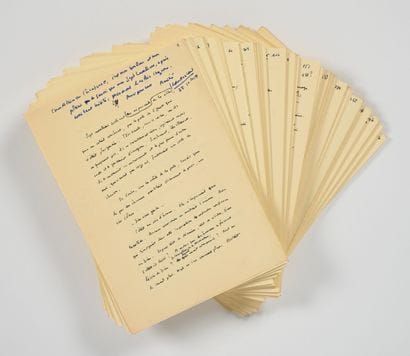
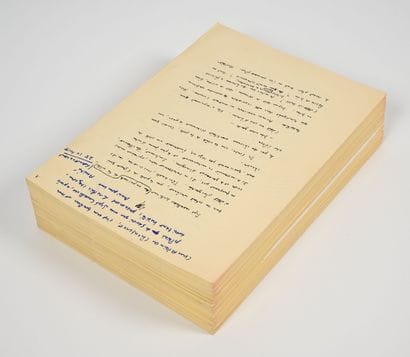
[AUTOGRAPH]. RASPAIL (Jean). LES YEUX D'IRÈNE. 387 folios on - Lot 166
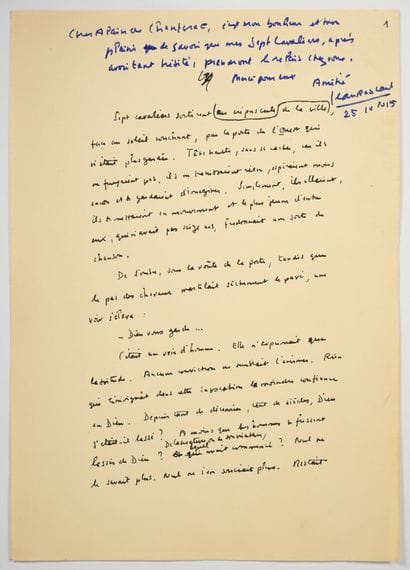
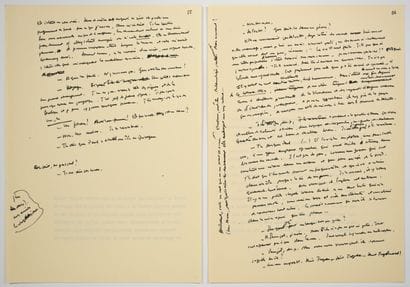
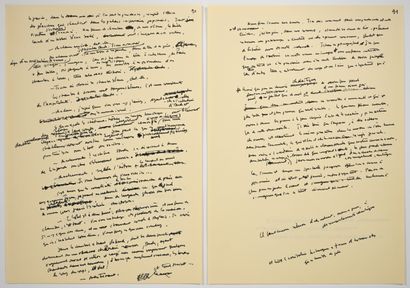
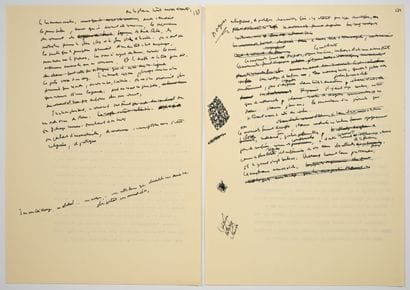
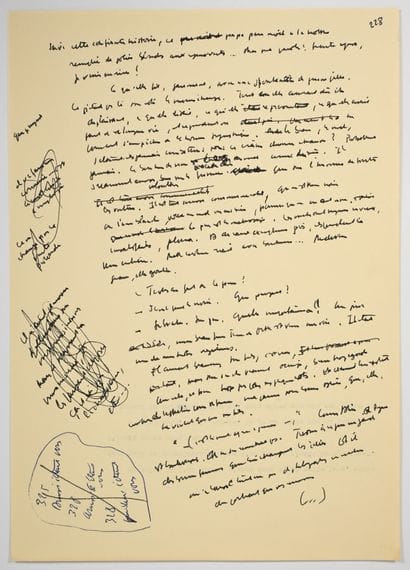
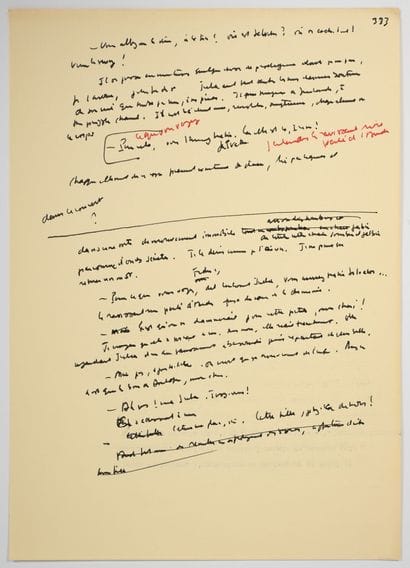
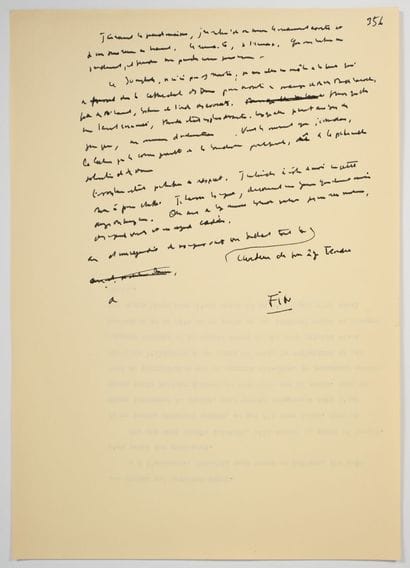
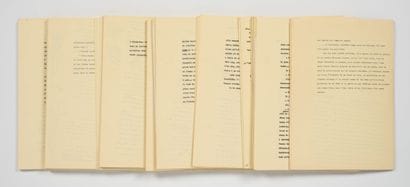
[AUTOGRAPH]. RASPAIL (Jean). LES YEUX D'IRÈNE. 387 folios on straw-yellow laid Conquéror paper, A4 size (approx. 30 × 21 cm), numbered 1 through 356, written on the front (pages 3 and 4 are also handwritten on the back): Missing: folio 46—one folio 83 between ff. 57/58—2 ff. “60”—2 ff. “66”—1 f. “69 bis” - 1 f. “70 bis” - 2 ff. “81” - ff. 124/125 on the same page - ff. 128/129 on the same page - 2 ff. “138” - 3 ff. “149,” including the unnumbered one in the middle - ff. 151/152 on the same page - f. 168 cut in two with no text missing - 1 f. “177 bis” - 2 ff. “184”—1 f. “187 bis”—1 f. “201 bis”—following f. “206” Raspail grouped the folios numbered “201/203/203 bis/204/205/206/207” into three subfolders with the handwritten note “Is there some confusion in the numbering?...!!,” the pages “209 through 217 bis” with the handwritten note “209/217 bis?” and the pages “214? 215? as well as folio 208,” with the handwritten note “2 pages not placed / filed” — 2 folios “223” — 1 folio “226 bis” — 1 folio “249 bis” - 1 f. “254 bis” - 1 f. “265 bis” - 2 ff. “266” - 1 f. “274 bis” - 1 f. “276 bis” - 2 ff. “294”—ff. 301/302 on the same page—following f. “331,” a subfolder containing 5 ff. and the handwritten note “Duplicate page numbers: 332–336,” then repeated at no. 332—a half-page fragment on white paper numbered “341 bis.” The reverse side of the sheets usually contains a typewritten text (a full page or just a few lines), sometimes with typewritten or handwritten corrections. On the reverse of sheets nos. 9 and 10 is the identical notation: “JEAN RASPAIL / ‘SEPT CAVALIERS sortirent de la ville au crépuscule…’ / novel”: both pages are numbered “1” in the upper left corner. EXTENSIVELY CORRECTED AUTOGRAPH MANUSCRIPT of the novel “LES YEUX D’IRÈNE” by Jean RASPAIL (1925–2020), published by Albin Michel in March 1984. A genuine working manuscript, written in black ink—likely a first draft—it features numerous interlinear additions, deletions, corrections, cross-outs, substitutions, and marginal annotations, providing a particularly detailed account of the work’s genesis. Page 46 is missing, but it corresponds to a long passage deleted from the final text: in fact, a large portion of handwritten page 45 (beginning with “I had decided to hit the road […]”) up to and including the first third of folio no. 47 was deleted (“I said that it had gone badly,” which corresponds to the beginning of Chapter 4, page 52 of the text printed in 1984 by Albin Michel). In a handwritten note in pencil at the bottom of page 45, Raspail also seems to question the veracity of his account, which would explain its omission from the final text. ATTACHED: A blank A4 sheet with a color coat-of-arms letterhead reading “Cavalerie Margravine / Escadron Colonel-Major Silve de Pikkendorff” [Colonel-Major Silve de Pikkendorff is the hero of the novel *Sept cavaliers*, published by Raspail in 1993], containing the following handwritten text: “Note: The pages of the MS [manuscript] of *Les Yeux d’Irène* are identical to pages 1 through 4 of the MS [manuscript] of *SEPT CAVALIERS*. J.[ean] R.[aspail] December 2009.” At the top of the first page of the manuscript is the following HANDWRITTEN DEDICATION: “Dear Alain de Chantérac, it is my joy and pleasure to know that my *Sept Cavaliers* [sic, instead of *Les Yeux d’Irène*], after so much hesitation, will now be published by your press. Thank you on their behalf. With friendship / Jean Raspail / October 25, 2015.” The lunch following which the writer wrote the dedication had been, according to the recipient’s recollection, quite boozy: which is why Jean Raspail confused the two novels, writing “Sept cavaliers” instead of “Les Yeux d’Irène”… But the autographed note from December 2009 nevertheless shows just how aware the author remained of the physical and textual connection between the two manuscripts. A UNIQUE NOVEL in Jean Raspail’s body of work, “Les Yeux d’Irène” pits two female characters, Irène and Aude, against one another, each associated with opposing principles: water and fire, day and night, God and the Devil. The manuscript, in perfect condition, constitutes—due to its length, its completeness, and the density of its corrections—A LITERARY DOCUMENT OF THE HIGHEST ORDER ON THE WRITER’S WORKING METHOD.
Sale information - Sale of Antique and Modern Books - Autographs - Photographs
Expert: Mr. Eric CASTERAN
Study Contact: Olivier COJEAN - 05.61.12.52.03 - cojean@mm-encheres.com
Public Viewings: Tuesday, November 10: 9:00 a.m.–12:00 p.m. / 2:00 p.m.–6:00 p.m. & Thursday, November 12: 9:00 a.m.–11:30 a.m.
(Responses to inquiries will not be provided until Friday, November 6... Thank you for your patience!)
My orders
Sale information
Sales conditions
Return to catalogue